

Tiny Windows into a Vast Future
Prof. David Eisenberg of the Technion in Science: Porous Structures as the Foundation for the Future of Energy
According to researchers at the Technion – Israel Institute of Technology, the future of energy lies in technological breakthroughs in porous materials, whose influence extends across diverse fields – from computing systems to biomedical engineering. Published in Science, their findings present a long-term roadmap for the evolution of the energy sector.
The article’s lead authors, Prof. David Eisenberg and Dr. Eliyahu Farber, a former doctoral student from the Nancy and Stephen Grand Technion Energy Program and the Schulich Faculty of Chemistry, explain that porous materials are already widely used in the energy world – for example, in fuel extraction from deep underground and electrical charge conduction in batteries. “Porous materials represent a fascinating meeting point between being and nothingness, between matter and void,” said Prof. Eisenberg. “Each of these ‘parts’ can conduct energy – whether in the form of matter, electrical charge, heat, radiation, or even mechanical pressure.”


Porous materials are a fundamental building block of most technologies used for energy production, conversion, and storage. The Technion researchers assert that improving technologies in these areas depends on intelligent, precise design of a porous structure tailored to the desired application. Such design enhances mass and charge transfer within the porous material, thereby improving the system’s energy efficiency.
The researchers analyzed a series of advanced technologies, including biomimetic (nature-inspired) structures, to identify trends in the evolution of porous architectures across various technological fields. Future applications could include chip manufacturing using porous materials – potentially reducing the power consumption of electronic and computing systems, and new ways to absorb mechanical energy in implanted joints.
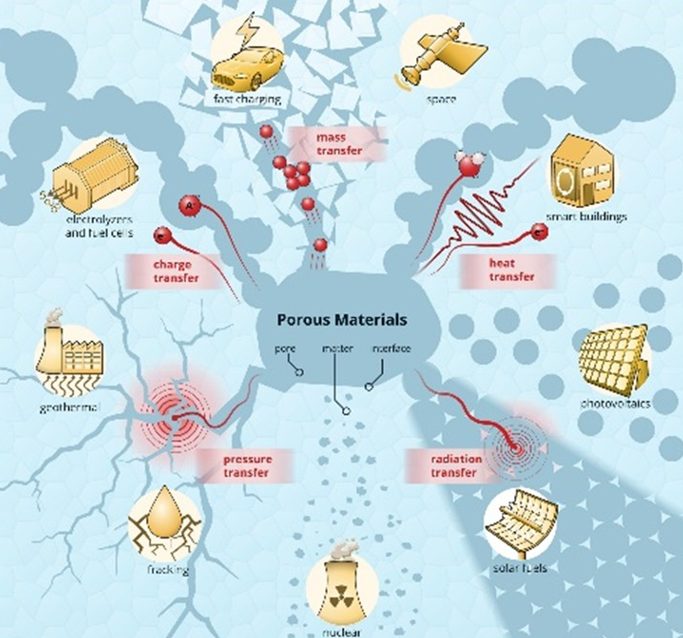
Eliyahu Farber began this research during his doctoral studies and continued it while working as a researcher at a flow-battery startup in Munich, Germany. In their paper, the researchers present fundamental principles that apply across size scales – from individual atoms to macroscopic systems. Based on these principles, they developed general models for predicting energetic properties and improving processes of energy generation and storage. They hope the models presented in the article will accelerate research and development of new materials for a wide range of applications – solar cells, batteries, electrochemical cells, and fuel production – thus helping achieve essential global energy goals.
The research was supported by the Israel Ministry of Energy and Infrastructure.
Read the full article – here